

 Ross Brackenridge
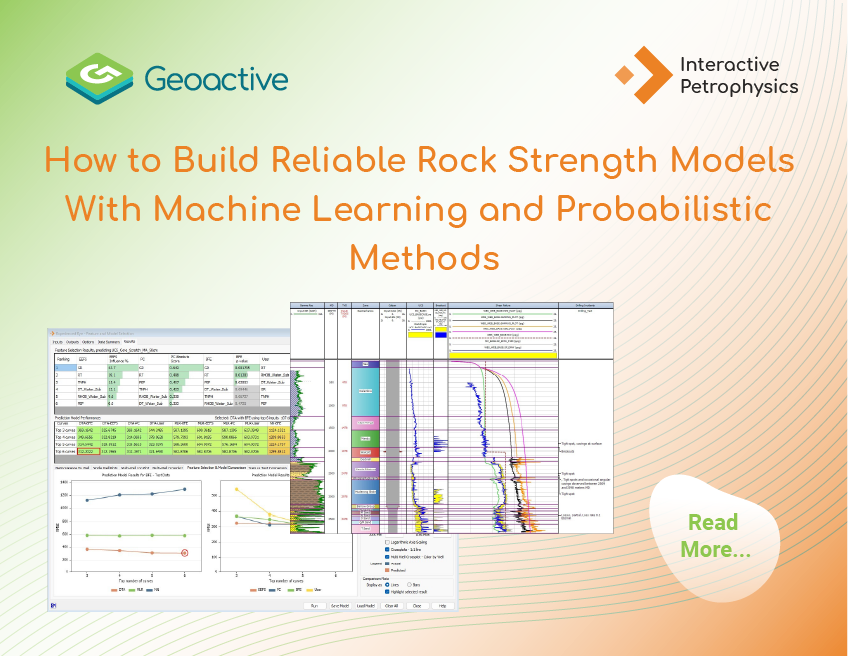
How to Build Reliable Rock Strength Models With Machine Learning and Probabilistic Methods
 Frans Mulders : September 22, 2026
That gap is a symptom of how the industry has evolved, and it's one that's starting to matter a great deal more than it used to.
Cased hole logging has long been treated as a specialist, almost niche, corner of geoscience: something handled by a small pool of experts or handed off entirely to a service company. For much of the industry's history, that made sense. Exploration and appraisal drove the agenda, and open hole evaluation got the investment and the training budget.
That balance is shifting. In mature basins like the North Sea, the emphasis has moved decisively away from discovery and evaluation and toward monitoring, surveillance and optimising what's already been found. Wells are older, reservoirs are better understood but constantly changing, and the questions operators need answered - where's the fluid contact now, is there flow behind casing, is the cement still doing its job, how is the reservoir depleting - are cased hole questions. As that shift continues, the geoscientists who build strong cased hole capability will be the ones best placed to answer the questions the job now revolves around.
Part of the reason the knowledge gap persists is that cased hole logging isn't just open hole evaluation in a different environment. The tools are different, the physics behind the measurements are different, the objectives of the logging programme are different, and the interpretation demands its own software and its own way of thinking. A geoscientist can be highly competent in open hole petrophysics and still find a pulsed neutron dataset genuinely unfamiliar territory. This is a reflection on how narrowly the two disciplines have historically been taught and practised, rather than a reflection on skills and ability.
The result, for many organisations, is a workaround rather than a solution: outsourcing cased hole interpretation to specialist consultants or leaning on the service company's own interpretation of the data. That was understandable, and for years it was often the only practical option as cased hole workflows generally weren't available within the main subsurface software packages operators already had in-house. But that barrier has now changed, and the workaround comes with a cost that's easy to overlook.
The most significant of those costs is integration. A service company analyst, however good, is usually looking at one dataset at a time, often without the full context of the well's history or the operator's wider objectives. The operator, by contrast, is the only party with access to everything, including every log, intervention and piece of production history. That complete picture is what turns individual cased hole measurements into real insight about a well's condition, performance and remaining potential. Piecemeal interpretation, however technically correct, tends to miss what an integrated view would catch.
There's also a quieter, structural pressure at play. Industry consolidation and cost discipline mean geoscientists are increasingly expected to be adaptable across disciplines rather than staying within one narrow specialism. In that environment, cased hole literacy stops being a nice-to-have and starts being part of what makes someone genuinely useful to their team.
My advice to organisations navigating this is to take ownership of the data and build in-house expertise. That doesn't necessarily mean every geoscientist needs to become a cased hole specialist overnight. It means getting the wider team to at least an awareness level, so they understand what the data can and can't tell them and can ask sharper questions of logging vendors. Even better if they invest in the right training and software to get more integrated insights, more confidence in the conclusions used for decisions, and a reduction in the ongoing cost of outsourcing.
The answer to that question depends on where you currently sit on the spectrum of cased hole knowledge.
Cased hole data is only going to matter more in Oil & Gas geoscience from here on, but its usefulness doesn’t stop at the industry's edge. The same cased hole skills are increasingly in demand in adjacent, fast-growing sectors like geothermal and carbon capture and storage (CCS), making this one of the more transferable capabilities a subsurface geoscientist can build today. The organisations and individuals who get ahead of that now will be the ones setting the pace, not catching up to it.
 Ross Brackenridge : May 14, 2026
As the oil and gas industry matures across provinces such as the UK Continental Shelf, the focus of asset management inevitably shifts. For late life...

 Andy McDonald : September 20, 2023
When planning and building machine learning models, a question often asked is, “What features should I use as input to my model?”.