

 Frans Mulders
1 min read
Geoscientists: Are You Adapting to the Maturing Market?
Ask a geoscientist to talk you through an open hole log suite, and most won't miss a beat. Ask the same person to interpret a cement bond log, a...

Rock strength is one of the most influential inputs in any geomechanical model, affecting wellbore stability, mud weight design, sand production risk, completion integrity, drilling performance and field development decisions. Yet rock strength data are often sparse, incomplete or unavailable, and even where extensive datasets exist, uncertainty remains regarding how applicable a model is outside the formations or wells where it was developed. The objective is not to eliminate that uncertainty but to understand, quantify and manage it.
In the following, two contrasting scenarios are examined. The first involves a data-rich environment where hundreds of UCS scratch test measurements are available. The second considers a data-poor environment where little or no core data exists. Rock strength models are developed for both situations, and the associated uncertainties are explored and compared.
In the first case, machine learning techniques were applied to UCS scratch test data obtained from conventional core samples. One single UCS rock strength model was successfully developed to match the scratch test data across several lithologies, including sandstones, shales and coal, demonstrating that machine learning can generate highly robust rock strength models.
However, machine learning requires careful guidance. Not all algorithms produce equally reliable results, and the quantitative selection of appropriate input curves is a critical step in the modelling process. Simply including any available feature or log curve does not guarantee a good model. To address this challenge, Interactive Petrophysics’ (IP) Experienced Eye was used to predict UCS rock strength. Experienced Eye is an automated model-selection workflow that ranks candidate machine learning algorithms and input feature combinations.
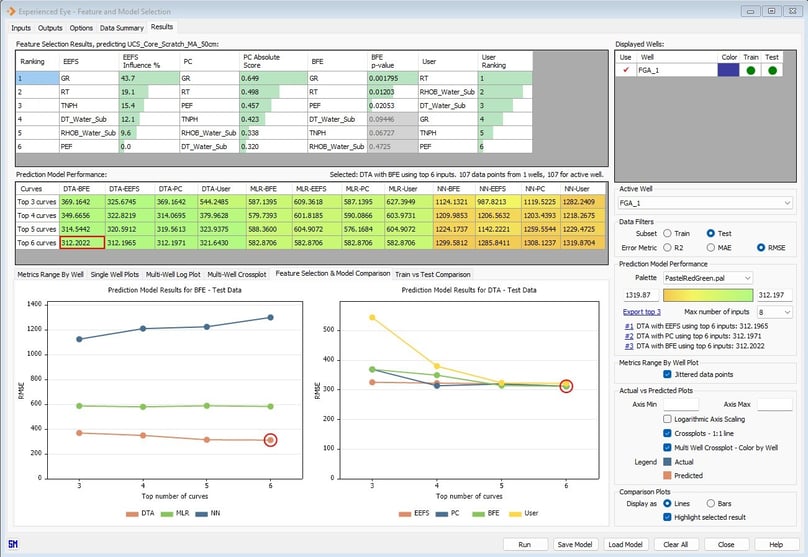
Experienced Eye Results – Sandstones/Shales/Coal – RMSE. Domain Transfer Analysis gives the best results. Both Multi-Linear Regression and Neural Network do not produce a satisfactory model. GR, RT and TNPH combined contain most information for a robust UCS model. Adding additional curves (e.g. RHOB, PEF, DT) slightly improve the strength model.
In this study, several performance metrics, including Root Mean Square Error (RMSE), Mean Absolute Error (MAE) and Coefficient of Determination (R²), consistently indicated that Domain Transfer Analysis outperformed Neural Networks and Multi-Linear Regression. Among the input features evaluated, Gamma Ray (GR), Resistivity (RT) and Neutron Porosity (TNPH) produced particularly robust strength models. Adding additional curves such as RHOB, PEF or DT, either provided only marginal improvements, slightly weakened the model performance, or had no significant impact. In contrast, incorporating interpreted porosity logs (PHIT or PHIE) resulted in a noticeable degradation of model quality.
The study also demonstrated that uncertainty remains even when highly robust rock strength models are developed from extensive datasets. When applied to different wells or formations, model performance depends on the degree of compatibility between the formations used for model development and those to which the model is applied. Petrophysical cross-plots can be used to assess this applicability and identify potential limitations.
The second case focuses on rock strength modelling in situations where little or no core data is available. Many projects still operate in data-poor environments where traditional correlations and uncertainty analysis remain essential. It is shown that, even in such data-poor environments, published rock strength correlations combined with uncertainty analysis can be used to generate practical rock strength ranges. These ranges can subsequently support geomechanical applications such as wellbore stability analysis.
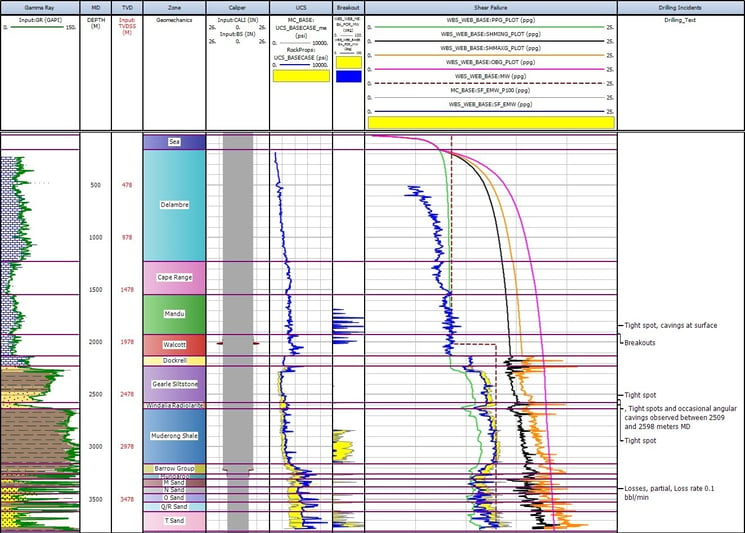
Monte Carlo Results for Uncertainty in UCS Rock Strength. Yellow bands represent uncertainty in: UCS input, Calculated Shear Failure Gradient (0 degrees allowable breakout angle), Calculated breakout angle for the defined mud weight
An example is presented to illustrate how rock strength uncertainty affects the recommended mud weight for a well. Deterministic wellbore stability calculations using low-case and base-case rock strength scenarios are compared with probabilistic results generated through Monte Carlo analysis. As drilling progresses, operational observations and drilling experience can be used to reduce uncertainty and further constrain rock strength estimates.
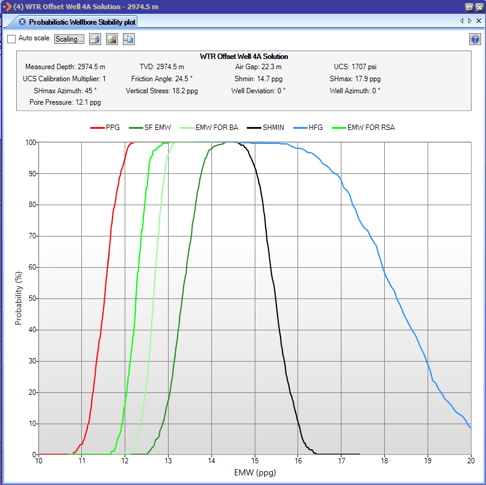
Probabilistic Wellbore Stability Plot Showing Monte Carlo Results for Uncertainty in UCS Rock Strength, Friction Angle, Shmin, SHmax and Pore Pressure
The key conclusion is that abundant datasets enable the development of robust rock strength models. In this study, the combination of machine learning methods and scratch test data allowed the development of a single rock strength model applicable across multiple lithologies. Nevertheless, the applicability of such models to other wells or formations must always be verified.
At the other end of the spectrum, reliable rock strength modelling remains possible even when data is sparse or absent. Published correlations and existing strength models can be applied with confidence to generate reasonable and practical rock strength uncertainty ranges. These uncertainty ranges can then be progressively narrowed as additional drilling information becomes available.
Ultimately, uncertainty is not a problem to be avoided, but a reality that must be understood, quantified and managed. Core data plays a vital role in reducing and managing that uncertainty.
Join my webinar to see real-world examples of both data-rich and data-poor workflows to model rock strength, learn how machine learning can improve rock strength prediction, and discover practical methods for quantifying and managing uncertainty in geomechanical models.
Alternatively, you can contact us directly to discuss how these approaches can be applied to your assets.

1 min read
Ask a geoscientist to talk you through an open hole log suite, and most won't miss a beat. Ask the same person to interpret a cement bond log, a...

As the oil and gas industry matures across provinces such as the UK Continental Shelf, the focus of asset management inevitably shifts. For late life...

 Andy McDonald : September 20, 2023
When planning and building machine learning models, a question often asked is, “What features should I use as input to my model?”.