As the oil and gas industry matures across provinces such as the UK Continental Shelf, the focus of asset management inevitably shifts. For late life wells, the emphasis is no longer on exploration or development, but on maximizing remaining value, ensuring operational integrity, and enabling safe and efficient abandonment.
In this phase of the asset lifecycle, cased hole data becomes central to decision making. Unlike open hole logging, which is acquired during or shortly after drilling, cased hole measurements can be obtained at any point after casing installation, throughout production and into plug and abandonment (P&A) operations. The objectives of cased hole logging are therefore fundamentally different: rather than focusing on asset growth and development, operators now seek to diagnose production issues, quantify remaining reservoir potential, and verify well integrity.
Geoactive’s Interactive Petrophysics (IP) software provides a comprehensive, vendor agnostic solution for analyzing cased hole data, enabling operators to confidently manage late life wells while balancing economic, safety, and regulatory requirements.
Maximizing Value Prior to Plug and Abandonment
As a well approaches the end of its productive life, operators aim to optimize recovery and defer abandonment costs wherever possible. Common late life interventions include:
• Water shut off through mechanical or chemical plugs.
• Re perforation of existing producing intervals.
• Perforation of bypassed or unswept pay zones.
Sound operational decisions depend on a clear understanding of both current downhole flow behavior and remaining hydrocarbons behind casing.
Production Profiling with Production Logging Tools (PLTs)
Production Logging Tools provide direct insight into the multi phase flow behaviour of producing wells. By measurement of integrated sensors across perforated zones, PLTs support the diagnosis of issues such as water breakthrough, cross flow, or under performing intervals.
The Production Logging module in IP transforms raw PLT data into actionable results by providing robust, interactive workflows for flow profiling.
IP Production Logging Module
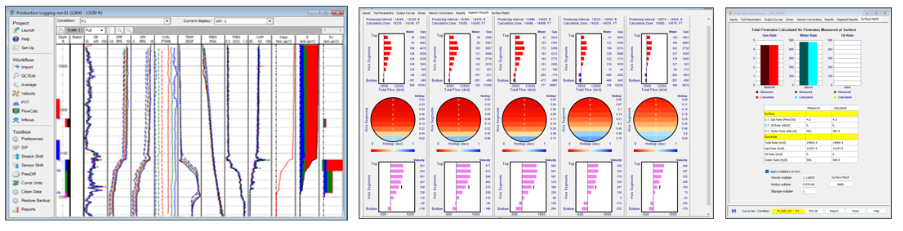
Images. IP Production Logging Module.
Purpose
• Quantifies downhole multi phase flow profiles and calculates zonal production contributions for oil, gas, and water.
Key Features
• Adaptive workflows compatible with all major PLT types, including array based tools for deviated and horizontal wells.
• Rapid data import, depth matching, editing, and quality control.
• Integrated spinner calibration, velocity modeling, PVT handling, and flow rate calculations.
• Clear, defensible outputs including final composite plots, zonal summaries, and automated reports.
Identifying Remaining Hydrocarbons with Pulsed Neutron Logging
Pulsed Neutron (PN) tools allow operators to evaluate reservoir fluid saturations behind casing, even in wells that have been producing for decades. These measurements are critical in identifying bypassed or remaining hydrocarbon potential prior to intervention or abandonment.
IP offers dedicated Pulsed Neutron interpretation workflows designed to handle a wide range of reservoir environments and tool specifications.
IP Pulsed Neutron Modules
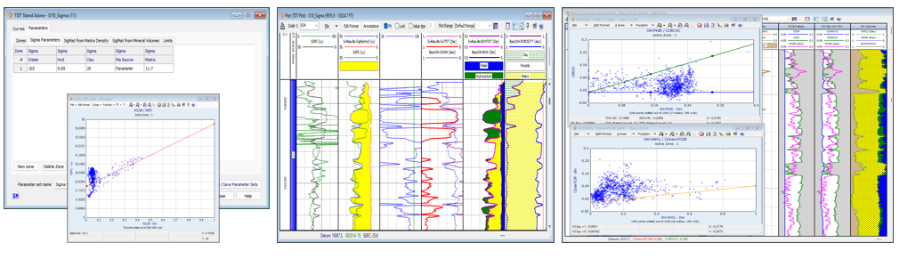
Images. IP Pulsed Neutron Modules.
Purpose
• Computes behind casing fluid saturations and identifies remaining hydrocarbons.
Key Features
• Sigma based water saturation workflows for known, high salinity environments.
• Carbon Oxygen (C/O) workflows for low salinity, mixed, or uncertain salinity conditions.
• Vendor neutral support for all major pulsed neutron service providers.
• Integrated model management for importing or building tool and environment specific response models.
• Fully interactive interpretation environment, allowing users to instantly assess sensitivity and uncertainty.
Benefits of Cased Hole Production Evaluation
By combining PLT and Pulsed Neutron analysis within IP, operators gain:
• A clear understanding of current production contributions.
• Quantification of remaining reservoir potential.
• Improved confidence in intervention decisions such as re perforation or water shut off.
• Extended economic life of late stage assets prior to abandonment.
Preparing for Safe and Efficient Abandonment
Once a well is designated for P&A, attention shifts to well integrity and barrier verification. Regulators increasingly require objective evidence that casing and cement systems are capable of providing long term isolation between reservoir and surface.
Cased hole logging is essential for verifying these barriers.
Casing Integrity Assessment
Multiple logging technologies are available to evaluate casing condition, including:
• Mechanical multi finger calipers for internal geometry.
• Ultrasonic imaging tools for thickness and internal corrosion.
• Electro magnetic tools for metal loss and external corrosion.
While these tools generate large volumes of high density data, meaningful conclusions require expert processing and interpretation.
IP Casing Inspection Module
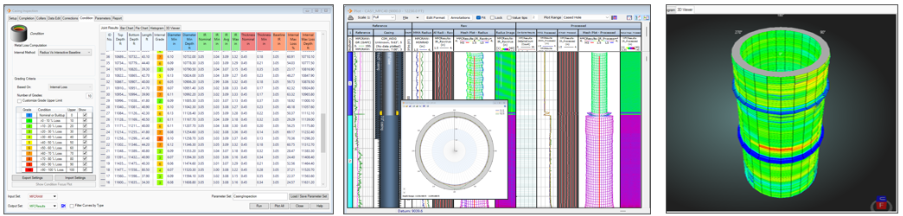
Images. IP Casing Inspection Module.
Purpose
• Assesses the structural condition of casing, liners, and tubing to identify wear, corrosion, and deformation.
Key Features
• Unified workflows supporting caliper, ultrasonic, and electromagnetic tools from all major vendors.
• Advanced re centering, normalization, and de spiking algorithms.
• Interactive collar detection and data editing.
• High quality 3D visualizations of casing geometry.
• Clear, joint by joint casing condition reports.
Cement Evaluation and Barrier Verification
Evaluating cement quality is critical to confirming annular isolation, both for production integrity and long term abandonment compliance. Acoustic cement evaluation tools—such as Radial, Segmented, and Ultrasonic Bond Logs—are widely used, though tool responses vary by vendor and design.
IP Cement Evaluation Module
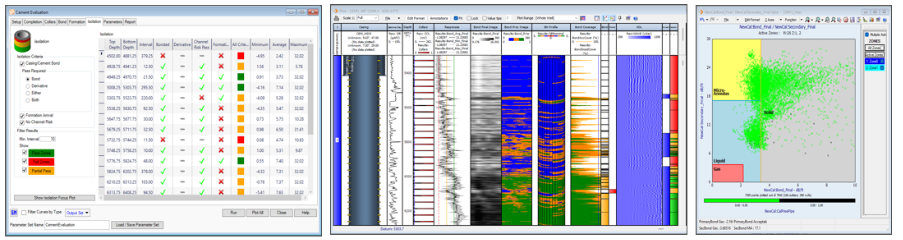
Images. IP Cement Evaluation Module.
Purpose
• Interprets cement bond data to assess cement presence and isolation quality behind casing.
Key Features
• Vendor neutral workflows supporting all major cement evaluation tools.
• Intuitive processing from raw data through to final interpretation.
• Traffic light isolation tables highlighting cement quality by depth.
• Specialized workflows for lightweight and unconventional cement systems.
Benefits of Using IP's Cased Hole Suite
By integrating cased hole data interpretation into a single, coherent platform, Interactive Petrophysics enables operators to:
• Improve well safety and regulatory compliance.
• Reduce uncertainty in late life operational decisions.
• Shorten interpretation cycles from raw data to conclusive results.
• Support defensible technical documentation for P&A approvals.
Conclusion
In the late life phase of oil and gas wells, cased hole data represents one of the most powerful sources of actionable insight. Through advanced, vendor agnostic workflows, Geoactive’s Interactive Petrophysics (IP) software enables operators to extract maximum value from aging assets while preparing for safe, efficient, and compliant abandonment.


 Ross Brackenridge


 Andy McDonald : September 20, 2023