Most petrophysical work sits in the machine learning layer, and naming the method matters
AI is in almost every conversation at the moment, everywhere from social media feeds to the titles of half the talks in a conference programme. Petrophysics and geoscience have not been isolated from this.
None of that enthusiasm is misplaced. The algorithms behind it are real and many of them have been in daily use for years, and even decades. What has happened in recent years is that the term "Artificial Intelligence (AI)" stretches to include a simple rule-based engine all the way up to a large language model writing Python scripts, drafting reports and carrying out operations automatically.
Within this article, we will separate out the terms that often get bundled together and put the everyday petrophysical tasks in the right bucket.
The AI and ML labels have drifted
Much of what gets called AI in petrophysics today was once called Machine Learning ten years ago, and before that, multivariate statistics. Over that period, computing power has grown, and with it the size of the models we are able to run. The naming has drifted too. What was once a regression model that predicts a missing log curve is now announced as Artificial Intelligence rather than Machine Learning.
When a Machine Learning regression model is renamed to AI, it can become harder to discuss it with your colleagues and friends. If it is relabelled AI, then it can obscure what is behind it and the next person still has to ask which methodology you ran, and what data and parameters were passed into it.
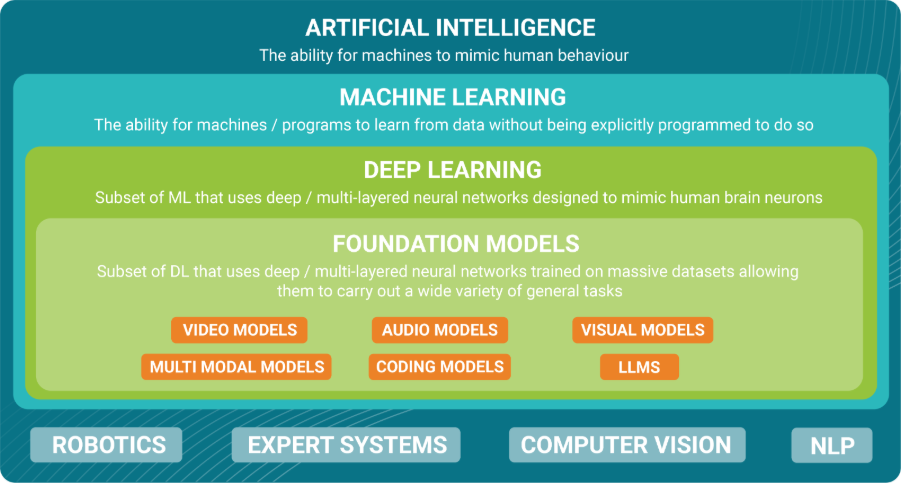
To help with consistency, we can define the three categories as
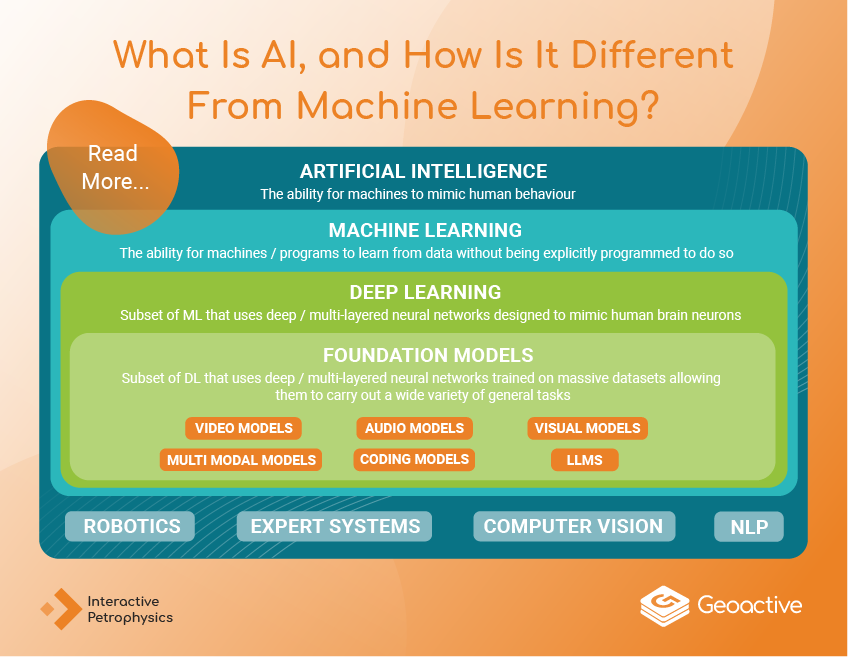
- Artificial intelligence is the umbrella term and is often defined as the ability for systems to mimic human behaviour, including understanding natural language, reasoning and problem solving. AI covers a rule-based quality check on a logging run at one end and a generative model producing synthetic logs and reports at the other.
- Machine Learning is a subset of AI which is focused on the ability for machines/programmes to learn patterns and relationships in data without being explicitly programmed to do so. Instead, they use algorithms and statistical models to carry this out. This is the layer that is commonly used in petrophysics for tasks such as predicting missing curves, identifying groups and patterns in the data that can be turned into rock types or facies, and repairing log data that has been impacted by poor borehole conditions. Find out more about ML in Interactive Petrophysics (IP).
- Deep Learning is a subset of machine learning that uses neural networks with multiple hidden layers. The algorithms here are designed to handle problems where the relationships in the data are too complex for simpler methods. However, they do come with the cost of needing more data and being harder to interpret. The transformer architecture behind today's LLMs is a deep learning architecture.
- Generative AI is one of the latest and most influential advancements in AI in recent years. These models have been trained on vast quantities of text, code and images, and can be used to generate new content rather than predicting just a number. The output is new in that it did not exist before, but it is assembled from patterns learned during training. Within petrophysics, they are increasingly being used for drafting reports, creating Python code, acting as a Q&A bot on your knowledge base, and much more.
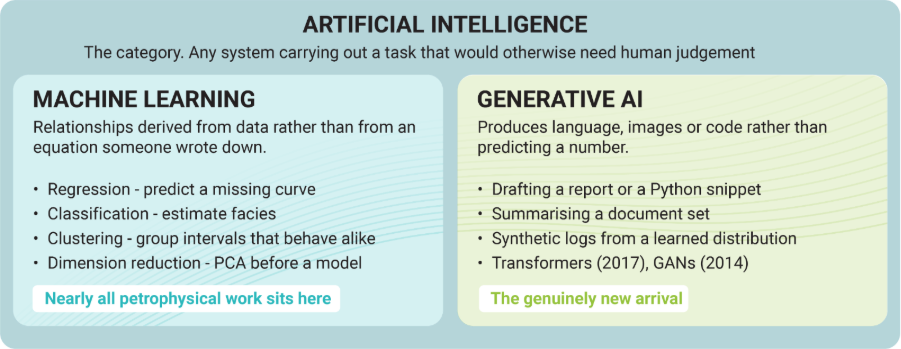
Most of today’s petrophysical work sits in the Machine Learning layer
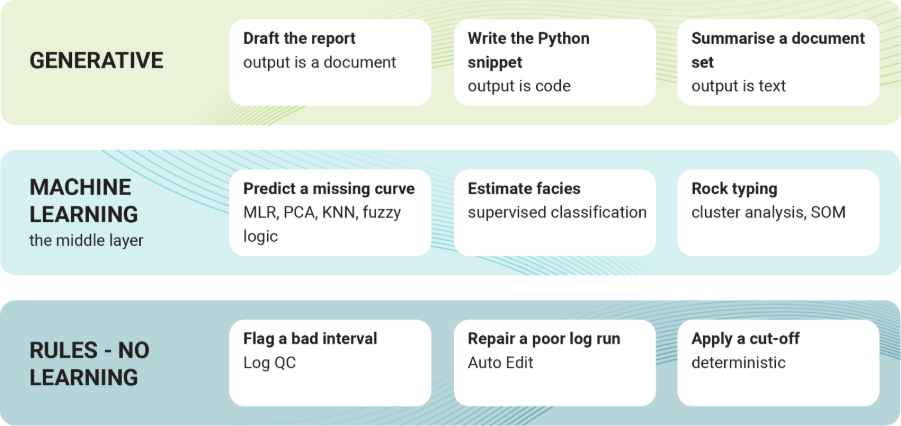
Using the definitions above, everyday petrophysical tasks land in specific places:
- Predicting a missing or poor-quality curve is a Machine Learning regression task. The model returns a number at every depth, learned from the wells or intervals where that curve does exist. Multiple Linear Regression, KNN and Fuzzy Logic all do this in IP.
- Estimating facies or lithology is a classification task. The model returns a label instead of a number, learned from intervals someone has already labelled. Fuzzy Logic, Neural Networks and KNN can be used to do this inside IP. Some of these methods appear here and above, and that is because what comes out depends on what the model was trained on and what the original problem was.
- Grouping wells or well log data that have similar values is clustering. These methods don't rely on labels and are referred to as unsupervised. Rather than being provided labels, they find groups in the curves, and the interpreter decides what, if anything, those groups mean geologically or petrophysically. Both Cluster Analysis and Self-Organising Maps can be used for this, and if you do have labelled data, you can calibrate the models to it afterwards.
- Flagging logging intervals that have been affected by poor borehole conditions or changes in the drilling environment generally needs a series of rules (e.g Caliper greater than 2” beyond bitsize) rather than a full Machine Learning model. In this situation, the interpreter sets the limits once and the same check can be applied on every well. The Log QC module in IP was developed around this premise and quickly flags intervals that fall outside of the expected norms.
- Drafting a petrophysical report or creating an automation and code through an AI model for a Python script moves into the Generative AI. Rather than the models outputting a curve containing numeric values, the output is words or code.
Generative AI is the part that is new
Generative AI is the class of models behind the current generation of foundation models, including Large Language Models (LLMs), and it rests on two developments. In 2014, Generative Adversarial Networks (GANs) made it clear that a model could produce new examples resembling its training data rather than a single predicted value. In 2017, the transformer architecture arrived, and that is the design today's LLMs are built on.
These tools are now used widely to summarise documents and research papers, write code, generate reports and even build interactive dashboards. What they produce is recombined from patterns in their training material, and that material does not include your proprietary wells or interpretations. They are best treated as a capable graduate rather than an oracle that knows everything, though their ability to reason, automate and generalise is improving quickly.
The model proposes and the petrophysicist decides
One area that often gets lost in the noise of the AI hype is that of whether these models should be fully automating the process or assisting the petrophysicist.
Many statistical models find patterns that can be slow to spot by eye, generative tools help with the code and the write-up. However, if left unsupervised they can have unintended consequences later down the pipeline. This is where the Human in the Loop becomes an essential component of the workflow. And we have been doing that as petrophysicists for years.
Computer assisted interpretation made a manual and sometimes lengthy process of interpreting a log, much faster and easier. But we moved along with that and made it an important part of the workflow to check the results make geological and petrophysical sense.
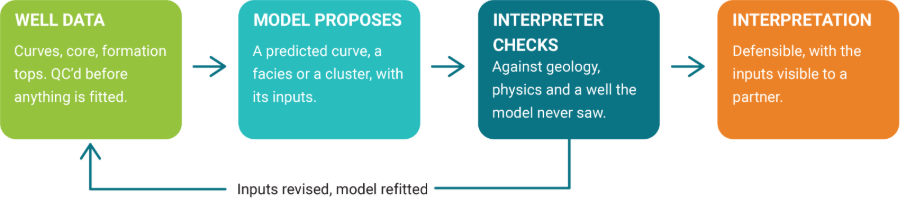
The same is true for any AI automation or process. The model proposes its suggestions, and we validate it and decide if it fits our view of the subsurface. When preparing reports, we should be naming the methods that we use, making their inputs visible, and describing the parameters and explainable features within the report.
We can call it AI if that is what the audience expects. But we need to ask what the model actually does to the data, because that is what decides whether we can trust the result.
Naming the method matters more than the category
When creating reports, presentations or papers, name the method used rather than the category. Where a workflow is bought or inherited, record which method was run and what it was trained on alongside the interpretation.
Interactive Petrophysics handles part of this already. Every curve carries a curve history that records the method and parameters used to create it, so the provenance stays attached to the curve. How the method is described in a report is still down to the author.
Three key takeaways
- AI is a category, not a method. Machine Learning is where most petrophysical work sits.
- Prediction, classification and clustering are Machine Learning. QC checks and cut-offs are rules.
- The curve name does not always tell you what was run on the data, but the method name, if stored, does.


 Andy McDonald
 Andy McDonald : June 12, 2025